
CenterPoint™ at Building Scale Is Paying Off
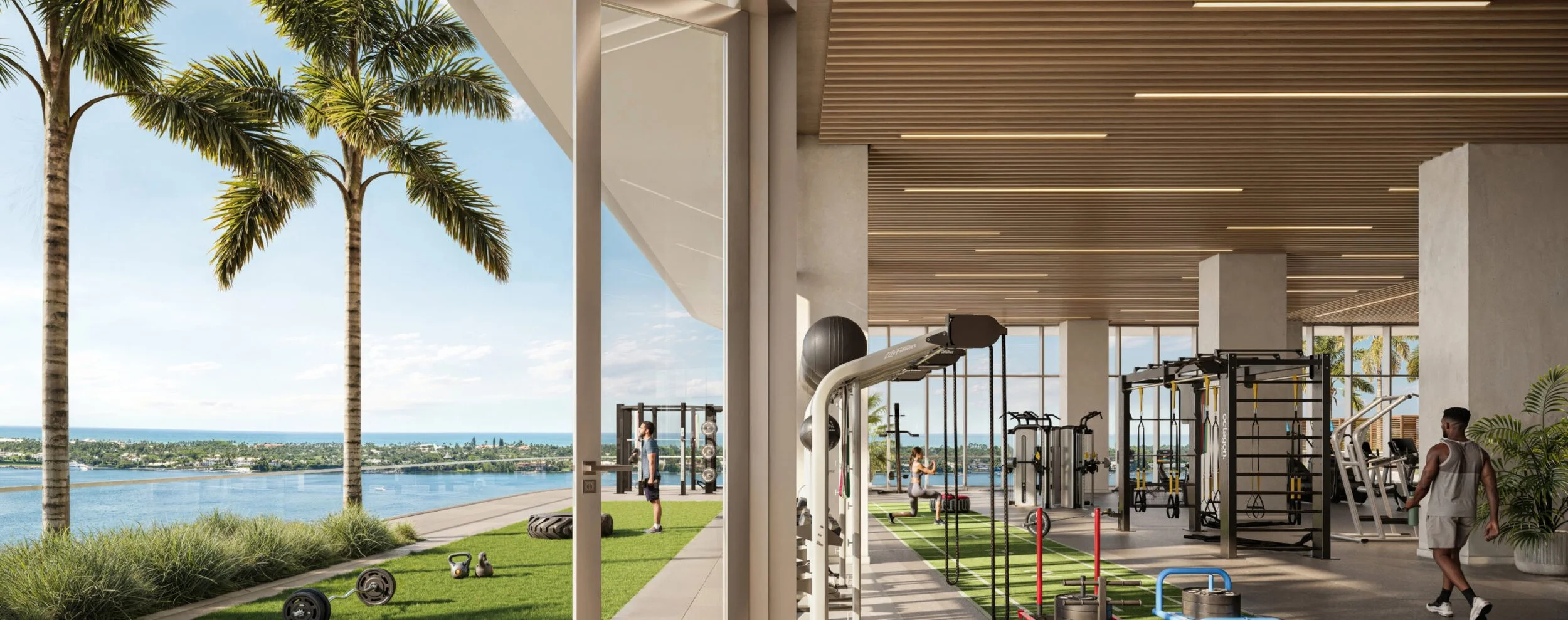
A CenterPoint™-inspired fitness environment integrating indoor and outdoor training within a South Florida residential community.
I've been working with a group of developers in South Florida who are building CenterPoint™ into their residential communities, and they're approaching it the way I always hoped developers would: with intention, from the beginning, as a system rather than an afterthought.
CenterPoint™ is my methodology for functional longevity. It operates across four domains, physical, emotional, cognitive, and spiritual, and it's grounded in the biopsychosocial model, which recognizes that human health is never just one thing. It's the interaction between biological, psychological, and social factors, all of them working together or working against each other depending on how you live. That model has decades of clinical research behind it and it shaped how I coached people long before I ever thought about applying it at building scale.
I developed this framework working with individuals. Athletes who needed periodization plans and recovery systems. Executives who were physically capable but emotionally running on fumes. People who had every resource available to them and still couldn't figure out why they felt off. CenterPoint™ gave them a coherent map. It replaced the guesswork with a framework that actually connects the dots between how you move, how you recover, how you think, and how you engage with the people around you.
What I'm seeing in South Florida is what happens when you take that framework and build it into the DNA of a residential community. Not as a branding exercise. Not as a line item in the amenity package. As the actual organizing principle behind what the building offers its residents every day.
The fitness program is designed around CenterPoint™ principles. So is the recovery offering. So is the programming that brings people together socially, because social engagement isn't a nice-to-have. The research on longevity is clear that isolation is a genuine health risk, and any wellness program that ignores the social domain is leaving a significant piece of the equation on the table.
From a developer's perspective, the argument for this kind of investment is straightforward. Buildings with coherent, credible wellness amenity programs perform better commercially. They absorb faster, they retain residents longer, and they command premiums that more than justify the upfront commitment. That's not a pitch. That's what happens when a building gives residents a real reason to stay and a real reason to tell other people about it.
The difference between a building that has wellness amenities and a building that has a wellness program is the difference between furniture and architecture. One fills a room. The other determines how the room works.
Most amenity programs are assembled from a catalog. Somebody picks a sauna, somebody picks a recovery room, somebody picks a few pieces of cardio equipment, and it all gets installed and called a wellness offering. There's no connective tissue. No framework tying the pieces together. Residents walk in, see a nice room with nice equipment, and then mostly stop using it within a few months because there's no reason built in to keep coming back.
CenterPoint™ solves that. It gives the program a logic, and it gives residents a reason to engage with it over time, across all four domains, in a way that actually accumulates into something meaningful for their health.
Watching this operate at building scale, after years of applying it one-on-one, is something I genuinely didn't anticipate when I first started developing the methodology. The framework scales because the principles behind it don't change based on how many people are using them. What works for an individual works for a community. The variables shift. The foundation doesn't.
If you're developing residential real estate and thinking seriously about what your wellness amenity program should actually do, this is the conversation worth having.
Enjoyed this? Visit TheWrightFit.com.